News
News
September 24, 2026
[Award] IFAC Fellow — Professor Hideaki Ishii —
Professor Hideaki Ishii of the Department of Information Physics & Computing, Graduate School of Information Science and Technology, The University of Tokyo, has been named an IFAC (International Federation of Automatic Control) Fellow.
IFAC is an international scientific organization founded in 1957 to advance the science and technology of automatic control. Covering a wide range of fields, from control theory and robotics to manufacturing, transportation, energy, and social systems, IFAC promotes international collaboration through conferences, publications, and other scholarly activities. IFAC is composed of National Member Organizations (NMOs), which are academic bodies representing individual countries and regions. In Japan, the Science Council of Japan has served as the NMO since the federation was founded.
The IFAC Fellow distinction is awarded to individuals who have made outstanding and exceptional contributions to fields within IFAC’s scope as researchers, engineers, technical leaders, or educators. Only a small number of fellows are selected every three years.
Professor Hideaki Ishii was selected as an IFAC Fellow for the 2023–2026 term in recognition of his contributions to the distributed control of networked systems.
The IFAC Fellow recognition ceremony was held during the IFAC World Congress, which took place in Busan, Republic of Korea, in late August.
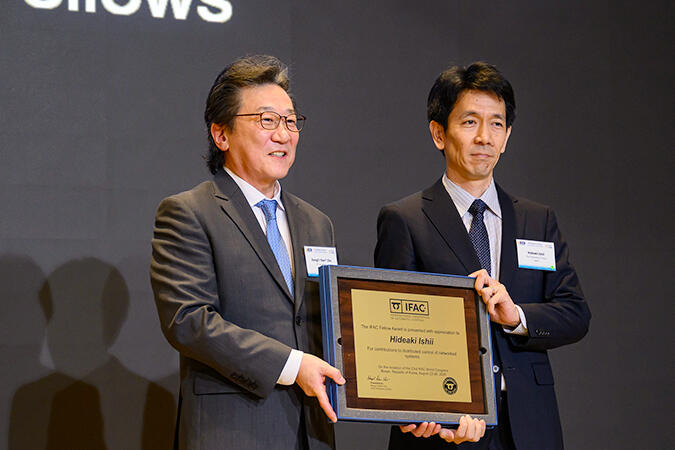
At the award ceremony:
From left, Dong-il Cho (IFAC President), and Prof. Ishii.
Message from Professor Hideaki Ishii
Department of Information Physics & Computing
Graduate School of Information Science and Technology, The University of Tokyo
I am deeply honored to have been selected as an IFAC Fellow. I would like to express my sincere gratitude to the many people who have supported my work over the years, especially my collaborators and students with whom I have had the privilege of conducting research.
I have been involved with IFAC for many years through activities such as serving on Technical Committees and the organization committee of the IFAC World Congress 2023 held in Yokohama. This recognition encourages me to continue advancing research in control theory and network systems, while contributing to the development of the international control community.
(This English article was translated with the assistance of AI.)